

Sonus Microsystems’ Autonomous Ultrasound AI Platform Selected for Major ARPA-H Maternal Health Award
Sonus’s ultrasound AI platform will power a point-of-care test that enables frontline clinicians to better assess placental health and flag pregnancies at risk of fetal hypoxia.
VANCOUVER, British Columbia, July 16, 2026 (GLOBE NEWSWIRE) -- Sonus Microsystems, the leader in autonomous and wearable ultrasound technology, today announced that its Sonus Patch™ AI platform will provide the foundation for a major award from the Advanced Research Projects Agency for Health (ARPA-H), an agency within the U.S. Department of Health and Human Services. The award, made under ARPA-H’s Making Obstetric Care Smart (MOCS) program, supports the development of a point-of-care test that provides clinicians with an objective measure of placental health and an early indication of pregnancies at risk of fetal hypoxia during labor.
The funded project is led by the University of North Carolina at Charlotte (UNC Charlotte) and includes Sonus Microsystems, the University of British Columbia (UBC), Atrium Health, and Oregon Health & Science University (OHSU).
Fetal hypoxia, a shortage of oxygen to the fetus during labor, is a leading cause of newborn death and lasting injury. The placenta supplies that oxygen, but its function remains difficult to measure. Conventional ultrasound produces an image of the placenta without measuring how well it is functioning, so problems are often detected only after the fetus is already in distress.
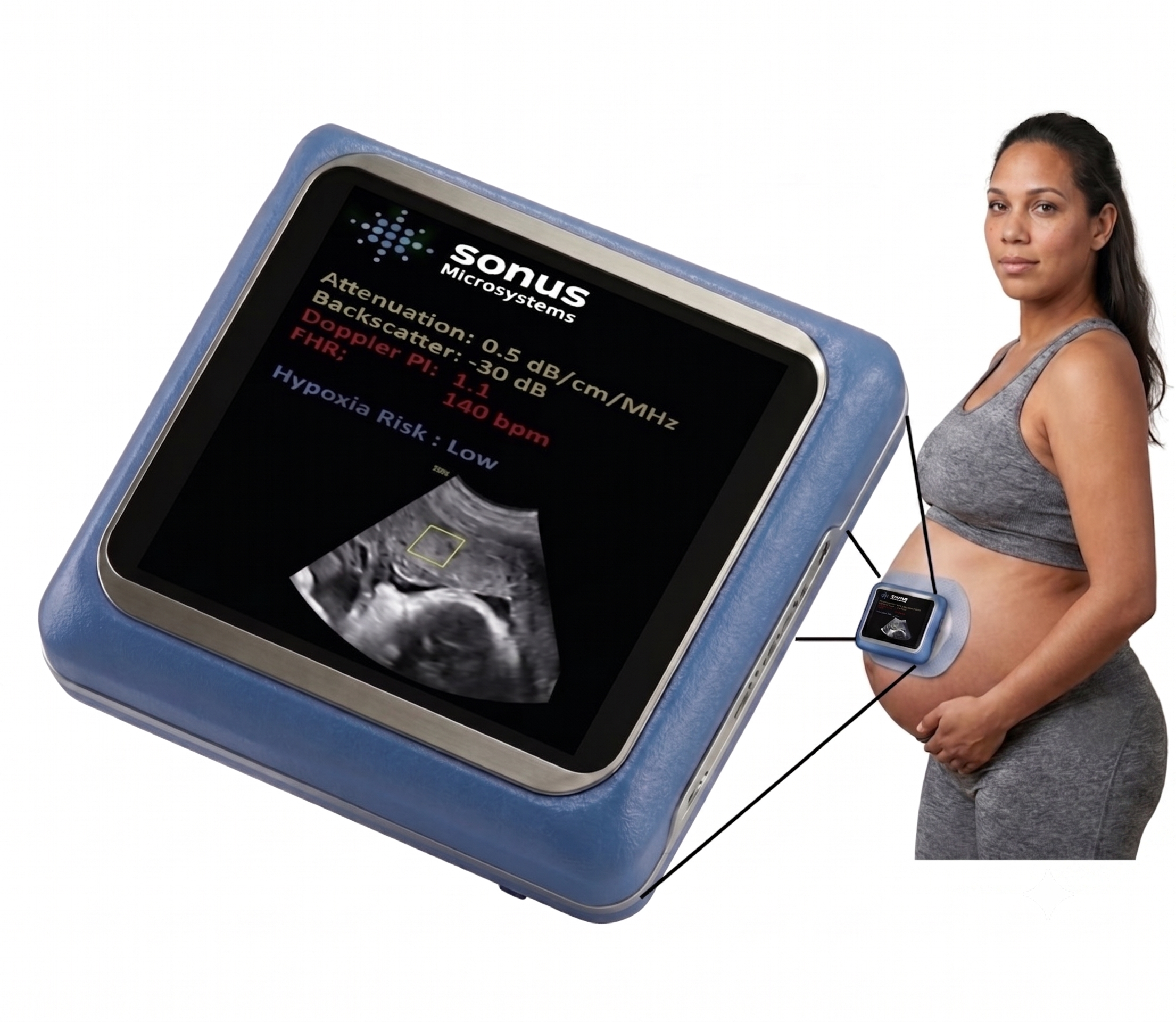
At the center of the system is the Sonus Patch™, the company’s wearable ultrasound platform. The patch is enabled by Sonus Array Technology, a polymer MEMS-based transducer that lets a thin, lightweight device cover a wide area without precise scanning. A clinician places it on the abdomen using simple external landmarks and performs a short scan, with no specialist positioning or image interpretation required. Sonus is developing the patch first for cardiac monitoring, and this program applies the same platform to maternal care.
The test running on the patch is QUS-P, a method co-invented at UBC and advanced at UNC Charlotte. It analyzes the raw signals beneath the ultrasound image to deliver consistent, repeatable measurements of placental tissue. The result is a quantitative readout that can be evaluated against a threshold rather than an image that requires expert interpretation.
“We built the Sonus Patch™ so that anyone can capture good ultrasound, not only a trained sonographer. Our beachhead is autonomous, wearable cardiac monitoring, and it is exciting to see the same platform extend to maternal care. We are honored to partner with this world-class team of researchers and clinicians to bring an objective placental reading to frontline providers.”
— Dr. Hani Eskandari, President & CEO, Sonus Microsystems
The Sonus Patch™ will be evaluated in clinical trials at BC Women’s Hospital in Vancouver and across Atrium Health’s labor and delivery units in the Greater Charlotte Area, North Carolina, where the clinical work is led by Dr. Julio Mateus Nino. The QUS-P algorithms behind the test are being developed by Dr. Farah Deeba’s team at UNC Charlotte, which leads the program, and Dr. Robert Rohling’s group at UBC, with placental biology and interpretation provided by Dr. Leslie Myatt at OHSU.
“For nearly a decade, we have worked to turn placental ultrasound from a subjective image into objective, quantitative information. QUS-P measures placental tissue properties directly from the raw ultrasound signal. What is exciting now is that running it on the Sonus Patch™ can make this information broadly accessible at the point of care, supporting better prenatal care for pregnant patients and their babies.”
— Dr. Farah Deeba, Assistant Professor & Principal Investigator, UNC Charlotte
The team is advancing a phased clinical program culminating in a large multi-site study, with the goal of a U.S. Food and Drug Administration submission and broader clinical use.
“At admission to labor and delivery, decisions about pregnancy care are currently made with limited objective information about the placenta. A quick, reliable test of the placenta that any member of the care team can perform at the bedside would help us identify the pregnancies that need closer monitoring and intervene earlier.”
— Dr. Julio Mateus Nino, MD, PhD, Maternal-Fetal Medicine Specialist and Clinical Lead, Atrium Health
More than 130 million births occur worldwide each year, and millions take place without a skilled provider on hand. A portable, objective placental test could help care teams identify who needs closer monitoring or transfer in both hospitals and lower-resource settings.
This research was, in part, funded by the Advanced Research Projects Agency for Health (ARPA-H). The views and conclusions contained in this document are those of the authors and should not be interpreted as representing the official policies, either expressed or implied, of the United States Government.
About Sonus Microsystems
Sonus Microsystems is the leader in autonomous and wearable ultrasound technology. The company's AI-enabled wearable ultrasound patch, powered by its proprietary Sonus Array Technology™, is designed to deliver autonomous, on-demand imaging outside of clinics and hospitals. With an initial focus on cardiac monitoring, Sonus is committed to expanding access to advanced medical diagnostics across care settings and in places where they can improve patient outcomes. For more information, visit www.sonusmicrosystems.com.
Media Contact: media-relations@sonusmicrosystems.com
A photo accompanying this announcement is available at https://www.globenewswire.com/NewsRoom/AttachmentNg/4042977f-cc62-4a40-bafa-4561ceca9f95

Sonus Patch wearable ultrasound for placental assessment
The Sonus wearable ultrasound patch and companion display, shown in the QUS-P configuration for autonomous placental assessment. Investigational device. Not cleared by the FDA. Displayed output is illustrative only.
Legal Disclaimer:
EIN Presswire provides this news content "as is" without warranty of any kind. We do not accept any responsibility or liability for the accuracy, content, images, videos, licenses, completeness, legality, or reliability of the information contained in this article. If you have any complaints or copyright issues related to this article, kindly contact the author above.
